Trail Wood
Over the course of my life, I’ve traveled a good deal and seen quite a few remarkable places. I’ve stood on the earthen wall Peter the Great had built to (unsuccessfully) hold back the Mongols. I’ve watched from the tip of the Gibraltar peninsula as the ships of the world passed back and forth through the ancient Pillars of Hercules. I’ve climbed the rusting engines of abandoned water wheels left from slave times in the rainforests of Tobago, but I’ve never managed a visit to the northeast corner of my home state, Connecticut.
This might be forgiven if I lived in Alaska or California, Texas, Florida, even New York, but I don’t live in one of these vast US states into which multiple countries might fit. I live in the third smallest state in the Union, only 5,600 square miles. It takes a mere two hours to drive across Connecticut from east to west (an-hour-and-half from north to south.)
Why haven’t I ever made it to the northeast corner? I don’t know anyone who lives there, for one. It’s also not on the way to anywhere, not to New York or Boston, not to Providence or Newport. It’s not on the way to the airport in Hartford, or farther north to Springfield, Massachusetts, the gateway to New Hampshire and Vermont. Though it may be “the quiet corner of Connecticut,” from where I live, it requires a drive on some of the most congested highways in the state: I-84 through Waterbury, I-84 or I-91 up to and through Hartford, roads pulsing with vehicles and often gridlocked from accidents or construction. Hartford, as my fellow Nutmeggers know, is a particularly bewildering series of turns, exits, and life-threatening lane changes.
But we did it last Tuesday, my sister and I, because we had a destination. We were headed for the tiny town of Hampton, population 1,732, and the Edwin Way Teale Memorial Audubon Sanctuary.
You all know Audubon, of course, but who, I hear you ask, is Edwin Way Teale?
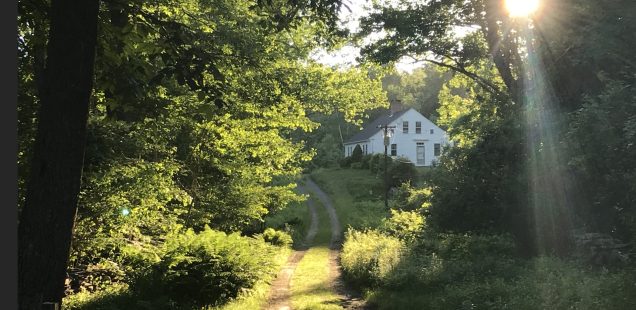
Edwin Way Teale was one of the foremost American nature writers of his day, winning the Pulitzer Prize in 1966 for a book called Wandering Through Winter. He was originally from the Midwest, but moved, with his wife Nellie, to New York City in 1924 so he could pursue his master’s at Columbia. After graduation, he wrote for Popular Science for many years and later went freelance. He and Nellie bought a house in Baldwin, Long Island when parts of western Long Island were still rural but left in 1959 as they became increasingly built up. If it was peace and quiet he and Nellie were after, they couldn’t have found a more peaceful or a quieter place than Hampton –still today– where they purchased 168 acres of land and an 1806 cape. They named it Trail Wood. Nellie, who outlived her husband by thirteen years, deeded it to the Audubon Society upon her death. The trails are open from dawn to dusk, the house by appointment.
Edwin Way Teale died in October, the month of my birth, so it was perhaps fitting that we arrived at his former home as the leaves were changing and the temperatures starting to cool. I had called ahead, primarily so we could see Teale’s study – kept, per Nellie’s instructions, exactly as he left it, as she had kept it: the calendar still open to 1980, the books and magazines he was reading still on the shelves.
He also maintained a writing studio on the pond just below the house, a log cabin built thick and sturdy enough to withstand an Arctic winter. Inside is an enormous oak desk, a wood stove, and a quality of silence only possible when thick log walls and large areas of woodland serve as your buffer. Farther along the shore of this pond, there is a screened viewing porch where he and Nellie used to sit and watch the birds and beavers and a Dawn Redwood Teale planted when they moved up sixty-seven years ago.
The estate is aptly named. Trails wind through the fields, the woods, and around the two ponds. The trails are wide and well-maintained, grassy, lending themselves to easy walking and quiet contemplation of the flora, the fauna, the birds who call from the trees or the long grasses, and the creatures who pop out from under ferns and bushes. Edwin and Nellie walked these paths daily, observing the slow, incremental changes of the seasons. There were, and still are, beavers in the ponds though –sigh— they did not reveal themselves to us last Tuesday. According to the caretaker, however, they are active and had just recently dragged a bench under the surface of the water. It has completely disappeared.
I came to know of Edwin Way Teale by accident. I was mooching through the nature section of my local library looking for something else when Wandering Through Winter, his Pulitzer Prize win, caught my eye. It was an older book with small rips in its plastic cover whose tape had gone yellow and brittle, its adhesive long dried.
I liked the title, read the book description, and decided to give it a go. I wasn’t put off by the fact no one had taken it out in decades. Quite the contrary. I love checking out forgotten books. It makes me feel like an archeologist lifting treasures from the sand. A week later I was in the more than a century-old one-room library in South Britain chasing down another book of Teale’s and presenting the library ladies at my own branch with a list of his books I wanted them to order through Interlibrary Loan.
When you read Teale’s books, you are aware that he was writing from another time though the beauty and intensity of his prose transcends the decades that have passed. It is, however, in a realm beyond the quality of the writing and the never-ending trove of new and interesting information where the true magic of Teale’s books lies. It is the magnetic power of his unmitigated wonder at the complexity and uniqueness of the natural world, the joy he took in seeking out examples of this complexity and uniqueness, whether it meant a car journey of many months or just a stroll down to the pond, and his wish to communicate this joy to you, his reader.
From Teale, I learned about the chirping calls of the rock rabbits, or picas, out in the Rocky Mountains and the Common Poorwill, the only bird that hibernates. I learned about the trails deer make in the winter snow, and the dune country on the southern shore of Lake Michigan. I learned about my country, places I’ve been to and many more that I haven’t.
There is an Artist-in-Residence program at Trail Wood. In the summer, over the course of six weeks, six different writers and visual artists each get a week to write, paint, take photographs, or in some other way react to the property Edwin and Nellie Teale cherished. Artists can walk the paths they walked, read the books he wrote and read, and watch beavers or birds or stars. There is an event at Trail Wood every September where the artists share their work with the public. I didn’t go this year, but I might in 2027.
Worth a drive up through Hartford.
To the quiet corner of my state.