A Typical Day
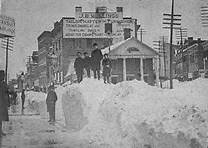
Last Saturday was a typical March day in Connecticut, which, for those of you unfamiliar with New England, isn’t much to crow about. Windy, in this happy case sunny, but still too cold not to bundle up. The land looked brown and mostly barren, but after the winter we’d had, the fact mountains of debris-coated snow no longer lined the driveway, obscured the front of our house, or lurked in the shadows of trees and bushes in the yard, the fact a new blizzard wasn’t in the offing, with another to follow seventy-two hours later, this merely chilly day felt like something to celebrate.
It was also nice to be able to use the word typical again, without sounding sarcastic. So little seems typical these days, neither the weather nor the headlines. To recognize something as just the way it was ten, or twenty, or fifty years ago, brought a deep sense of peace.
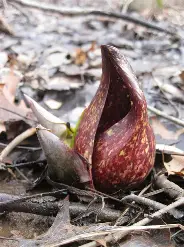
So I bundled up like a good New Englander, pulled on my battered Wellies, and marched down the lawn into the woods. My mission? To inspect the damp ground along the edges of the streams and in the boggy woodland depressions to see if the skunk cabbage was coming up yet. To my satisfaction and delight, its shiny purple tips were breaking through the soggy leaf cover everywhere. It was official! Early spring had arrived.
After establishing that the skunk cabbage had come back when it typically did, looking the way it typically does, I decided to wander around in the woods looking for other typical March experiences. Wandering in the woods around here, however, isn’t as simple as it used to be due to the torrential rains of two summers ago and the microburst of last July. Great gray tangles of mangled limbs and snapped off trunks and branches lie in dystopian heaps among the trees left standing. They clog large sections of the streams. These enormous impediments force detours for animals and humans alike, and as I skirted the edges of the piles, ducked under the sheared off branches, and scrambled over the scalable trunks, I understood that these uprooted trees would decay and disappear over time, sinking back into the landscape from which they had come. They would, as they did, provide nutrients to plants and shelter to insects and small animals. They must have afforded a good deal of shelter to some of the larger animals during the blizzards of the past winter, the snow heaped on the latticework of dead branches, storm-felled when they were still in leaf, forming a natural shelter from the extreme weather. Birds flew in and out of their drying limbs last Saturday, so the victims of flood and wind are providing shelter still, but each massive pile nevertheless felt unnatural to me, something that was there now, but hadn’t been there before, something imposed upon the forest floor, something atypical.
I made my way past one of these great jumbles to the bank of a stream. Here, deeper in the woods, the wind was less cutting, and the sun warmed the rock I sat down on. Too early for ticks, I told myself, only to be disabused of this notion a few hours later when a physician friend of ours said that people had already started coming into her hospital with Lyme’s and babesiosis.
But I didn’t know that while I was sitting on the rock, and I was able to enjoy the sound of rushing water and the birds calling to one another, innocently imagining I wasn’t yet surrounded by the danger of serious illness that has become typical here in the New England woods, most especially in Connecticut.
The western wall of the small valley we live in rose up a few hundred yards away, an old country road carved into its side. In fact, we had only that morning attended a lecture about the history of this road. Originally a Native American path, it was later widened by settlers to transport goods, livestock, and people from the interior town of Woodbury down to the Derby docks. It was one of the main old highways in the area from the 1600’s well into the 1850’s when the railroads came and other, larger ports down on Long Island Sound rose to greater prominence. Now it’s just an unpaved country road with underground springs scouring its surface, used mostly by walkers and locals with four-wheel drive. What was a typical March day like back when the Woodbury Path had oxen and stage-coach traffic and the house next door to us was an inn? Could you hear the rush of water and birdsong? Probably. But other sounds, too, the shouts of men and women, the neighing of horses and the lowing of oxen, the creak and slap of transport and machinery that are no longer in use. What’s typical changes with the years, with the centuries, lately, it seems, with each day.
Would the skunk cabbage have been coming up back then, melting the snow around it with its unique ability to generate heat? Did skunk cabbage even grow back then? It did. Dried or boiled, the Native Americans used it as a treatment for coughs, asthma and as an anti-spasmodic. (Enthusiastic readers, please don’t eat raw skunk cabbage! It will make you really sick.) I was careful not to step on any purple-and-green flecked bulbs last Saturday, not so much because the bruising releases the unpleasant odor for which the skunk cabbage is named, but because, grateful to this plant for being there, for coming back to life when it always does, I didn’t want to interfere with its growth cycle. I wanted to gift the skunk cabbage the typical day it had gifted me, growing low in the warming New England earth, soaking up the sun, the way it had for centuries.


I love this. I’m in the woods walking beside you.
This is splendid. The earth abides.
Thank you for these few minutes of peacefulness.
These are the moments for which I returned to Connecticut.
A beautiful homage to the Connecticut landscape. And to spring!
Love this! It was so descriptive that I felt I was right there, too. Thanks
Another great blog post. As a Connecticut resident , I also felt I was right there.