Cape Verde
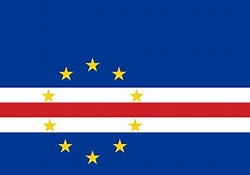
On sixteenth and seventeenth century world maps, the Cape Verde Islands were drawn larger than they actually were. This enlargement symbolized the psychological and practical significance of this tiny Portuguese colony for the ships and the men who sailed the waters of the Atlantic. Their sighting could mean safe harbor after a long and arduous journey, or the last port of call before setting out across capricious and unforgiving seas. It meant fresh provisions, repairs, medical attention, and most of all, human contact.
The days of sail came to an end. Ships became steam-powered, grew larger, and were able to carry more supplies. Yet even as the islands became less essential for provisions and repairs, they remained critical coaling stations. Then came the internal combustion engine, ships ran on bunker fuels, and Cape Verde’s coaling stations were no longer necessary. On today’s maps, the Cape Verde Islands are drawn to scale, ten variously shaped droplets bobbing in the sea three-hundred-and-fifty miles off the coast of West Africa. They are so small you often need a magnifying glass to see them. Sometimes you can’t see them at all.
But something remarkable happened recently, something that began on June 15th when, in their first World Cup match, the Cape Verdean national soccer team, the Blue Sharks, held the European champions, Spain, to a scoreless tie. It continued through the game they then played against Uruguay in which they scored twice to draw against the heavily favored South American side. It kept going with another scoreless match against Saudi Arabia and culminated in their extraordinary game against the reigning world champions, Argentina, in which a team ranked sixty-seventh in the world came within shouting distance of upsetting the soccer titans. Suddenly, and without warning, not on the actual maps of the world but on the maps people carry in their hearts and minds, Cape Verde grew large again.
In the media scramble to offer the viewing public information about this tiny country no one had heard of, much was made of its beaches and mountains, its laid-back lifestyle, its status as “the hidden vacation spot of Africa,” but the question was never asked, or never explored, why more Cape Verdeans live off these beautiful islands than on them, why a significant portion of the Cape Verdean national soccer team was not born on Cape Verde, but in the Netherlands, why nearly twenty percent of the population of Brockton, Massachusetts and ten percent of New Bedford is Cape Verdean.
The government of Cape Verde is considered to be one of least corrupt in Africa, and the United Nations Development Program (UNDP) recently ranked Cape Verde among the top ten countries in Africa for health, education, and standard of living. But despite this, despite all the advances and improvements, the painful fact remains that for centuries and still today, the ten islands of Cape Verde have never been able to support all their sons and daughters.
Blame it on the demise of the sailing ship. Blame it on the Portuguese who colonized verdant islands, clearcut the land for plantations, and loosed goats who decimated the vegetation and changed the climate. Now large parts of Cape Verde are desert-like. The islands have been plagued by drought and famine for hundreds of years.
Leaving is what Cape Verdean men have always done, on the whaling ships bound for America or for jobs in the ports of Lisbon and Rotterdam. Their families sometimes followed them, and sometimes they didn’t. When the whaling industry wound down in the New England ports of the United States, many Cape Verdeans continued to work on the waterfronts, or in the textile factories. Many of them picked our Thanksgiving cranberries.
The members of the Cape Verde national squad are the sons of the different islands of Cape Verde, but they are also the sons of families who left these islands for a better life. The defender, Sidny Lopes Cabral, who scored a goal against Argentina that even Messi would be proud of, was born in the Netherlands. When Pico Lopes, the Blue Shark’s center-back, went home, he flew Aer Lingus to Dublin.
Cape Verdeans have always been challenged by their circumstances, by the whims of weather, by colonizers, by the onward march of technology and the merciless reshuffling of global significance. To be Cape Verdean means to have inherited a legacy of departure and sodade, longing for the place you are not, for the ones you are missing. This longing applies whether you were one of the ones who left or someone who remained. It is this tough national legacy that gave twenty-year-olds their gravitas when they went out against the Spanish side, stuck to their defense, and captained by their forty-year-old goalkeeper, Vozinha, let not one goal through. It was this birthright of survival that allowed them to challenge the Argentinians, to have Messi looking decidedly worried, and when his team did finally prevail, to head off to the locker room without celebration, just happy to have gotten through.
The Fox commentators started the first Cape Verdean game predicting gloom and doom. It was sure to be another drubbing like the one Germany had just inflicted on Curacao. When, as the minutes ticked by and the Cape Verdeans, with save after save from Vozinha, kept the Spanish from scoring, the two studio analysts, both storied European soccer players Thierry Henry and Zlatan Ibrahimović, were asked to weigh in. Both Henry and Ibrahimović are the sons of parents who left their own countries for better opportunities. Henry was born in Paris, but his parents were island people, his father from Guadeloupe and his mother from Martinique. Ibrahimović grew up in Malmö, Sweden, but his father was born Bosnian and his mother Croatian.
It was incredible, they both agreed, unprecedented, for the Cape Verdeans to hold off the Spanish. They would not have predicted it.
They said the same thing after the Uruguay game and the one with Saudi Arabia, that the Cape Verdeans were punching above their weight, yet before the final game with Argentina, when asked to predict the outcome, both men hedged. “Anything could happen on any given day,” Henry said carefully, though you could tell what he wanted to happen. “It’s gonna be tough,” Ibrahimović said, wishing Vozinha good luck in the same kind of voice battlefield commanders must use when they’re sending men on hopeless missions. By the end of the game, however, in which the Cape Verdeans battled the Argentinians to 2-3, Henry was speaking in emotional Portuguese, thanking the Cape Verdean team for their performance. Ibrahimović admitted he was close to tears. “These guys are heroes,” he said. He wasn’t talking about the Argentinians.
Leading up to the 2026 World Cup, there was much discussion of FIFA’s decision to expand the number of national teams who could qualify to play. Letting tiny countries like Cape Verde participate, critics said, would lower the tone of play. Yet by the time the Cape Verdeans departed, it was generally agreed they had raised it.
“Cape Verde, thank you, on behalf of the world!!” Fox Sports commentator, Stuart Holden, cried as the final whistle of the Cape Verde – Argentina game blew.
What had just happened?
In a world in upheaval, in a time of rancor and dismay, soccer fans, no matter their political persuasion, could agree on what they had seen: a good thing, a pure thing, men playing without ego, the odds stacked against them, playing to represent a country and a people the world had forgotten, playing to put Cape Verde back on the map.



Lovely article Linda an inspiring education . I love the world cup all the different countries all with a common goal . If only real life could be so simple . Give my regards to Tony looking forward to seeing you guys in sept . Tom
Ditto here.
Excellent post! I think you may have missed your calling as a sportscaster..
I appreciate the historical and cultural perspective you bring to the story of this inspiring team, which gave the world the best gift: a moment of unity..
Cape Verde’s play was the highlight of the tournament, so far. Many people are now fans of soccer due to their passion. Excellent article.
And Spain has just won their semi-final 2-0 over France. But they couldn’t score against Cape Verde!
Linda, I really enjoyed this article. You educated me about Cape Verde and reminded me of what a pleasure it has been to watch the World Cup!
Well written, we have also been encouraged by this team.
The Cape Verdean soccer team was definitely the highlight of the WC. Their fierce determination and drive against soccer giants made us proud.
Such a beautiful and powerful reflection. Thank you for sharing this. As someone from Cape Verde, it means so much to see our history and culture explored with such curiosity and respect.